
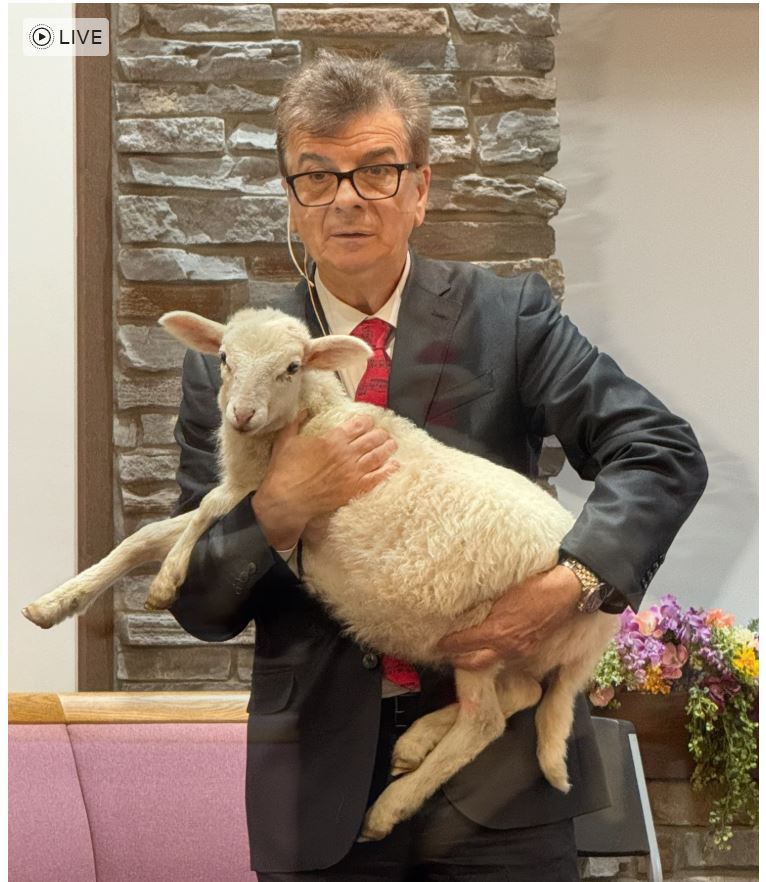
Pr's weekly message
Pastor's Corner
Weekly messages and reflections from Pastor Ovid Radulescu, guiding our church community in faith and spiritual growth.
October 24, 2026
The Signs We Miss
"Pastor, why don't you preach more clearly about the hot topics of our time? Midterm elections, national debt, rising living costs, Christian nationalism as a sign of the end times, the beast, the mark, and the Sabbath? Instead, you keep reminding us to maintain a personal devotional life and, annoyingly, to give Bible studies. Aren't these things common to all Christians, not just Adventists? Shouldn't we be more vocal about present truth?" Fair questions. We are a prophetic people with a prophetic message. We should know what we believe, why we believe it, and how to share it courageously. Our identity and mission matter, and the world is not getting any less complicated. But here is my concern: we can become experts at identifying the signs of the times while neglecting the signs of spiritual life in our own hearts. We can debate the mark of the beast while displaying the marks of bitterness, pride, and indifference. We can unmask the beast on a prophecy chart while failing to recognize the ugly attitudes we unleash on one another. We can defend the Sabbath while forgetting that the Lord of the Sabbath calls us to love our neighbors. Jesus warned that "the love of many will grow cold" (Mat. 24:12). Paul described (church) people having "a form of godliness but denying its power" (2 Tim. 3:5). The danger is not always abandoning religion; sometimes it is keeping its appearance while losing its transforming power. Before checking the temperature of the political climate, we should check the temperature of our love. My responsibility as a pastor is not merely to dispense religious information. Much of it is readily available in our books and official church websites. My calling is to guide people to encounter Christ, grow in their relationship with Him, and reach their full potential connected to Him. This is not a distraction from our prophetic mission. It is the essential part of its purpose. Yes, let's study prophecy, speak courageously about the state of our nation, and understand present truth. But let's also pray, give Bible studies (did I say this before? I hope so, because it's such a transformative experience for both teacher and student), forgive people, and love those who disagree with us. Prophecy should not merely help us recognize the approaching crisis; it should prepare us to remain faithful when it comes.
October 17, 2026
All I Need
We sing it with our eyes closed and our hands raised: "You're all I need. You're all I want." Beautiful. Moving. Not quite true. I've never had a moment when God was all I wanted. Some afternoons I wanted a nap. Some evenings I wanted pizza, without my tummy being bloated. And I can't honestly say God is all I need while I'm breathing oxygen, drinking water, and eating lunch. If God were all I needed, He wouldn't have bothered making lungs. Call it romantic truth: things that aren't factual but feel true. They sound deeply spiritual, but they don't survive an honest conversation. Look at Genesis. Adam has a perfect garden, a meaningful job (naming the animals, which must have been a long afternoon with his notebook filled with words), and unbroken fellowship with God. Then God Himself says, "It is not good for the man to be alone." Notice who said it. Adam didn't file a complaint. God did. He looked at a man walking in daily communion with Him and said, in effect, "I made you for Me, and I made you for each other." Now fast-forward to Elijah. He's just won a showdown with the prophets of Baal, and then he collapses under a broom tree, exhausted and ready to quit. What does God prescribe? Not a sermon. Not a ten-point self-improving plan. An angel shows up, taps him on the shoulder, and says, in effect, "Get up and eat." Then Elijah goes back to sleep. Then another meal. The great prophet's next step of faith was a nap and a snack. That's not a gap in God's sufficiency. It's His design. He is enough to sustain us, but He never said He was the only gift in the room. He gave us people, bread, and Sabbath rest, and He called it good. I suspect this is why many people walk away from faith. They hear clichés that don't match real life, and an honest person says, "That can't be true." They're right. But the truth is better than the cliché: God is the source of everything we need, including the people and the pizza. So tell the truth in your prayers. Admit you're tired. Thank Him for oxygen and H2O. And text/call the person you've been avoiding, because that's part of the plan too.
October 10, 2026
The Appreciation Problem
There is something slightly amusing about Pastor's Appreciation Day which technically is tomorrow, the 11th. For one day a year, the church officially remembers that pastors are human beings. We eat. We get tired. We occasionally forget where we put our keys. We have families who have learned that "I'll be home shortly" is a theological statement rather than a time estimate. And we appreciate being appreciated. But the truth is, ministry is not a one-man job. Behind every pastor who stands in the pulpit is a family that has learned to share him with hospital rooms, board meetings, phone calls, emergencies, funerals, weddings, Sabbath afternoons, and the occasional "Pastor, do you have a minute?" that somehow lasts 45 minutes. There are also colleagues - pastors, elders, teachers, deacons, ministry leaders, and friends - who carry burdens, solve problems, encourage when the batteries are low, and sometimes simply say, "keep going." A pastor may be the one holding the microphone, but many people are holding the other end of the rope. And then there is Jesus, thank you Lord! If ministry depended entirely on appreciation, many pastors would have resigned somewhere around Tuesday. Pastors discover something rather quickly: you can preach a sermon for which someone thanks you for months, and another sermon for which someone remembers only that you mispronounced a Bible name. You can spend hours helping someone through a crisis and then receive a phone call because the church thermostat is two degrees too warm. That is ministry. Jesus never promised His servants constant applause. In fact, He warned us that following Him could sometimes mean being misunderstood, overlooked, criticized, or simply unappreciated. But He did promise something better: "Well done, good and faithful servant." That is why today is not really about putting pastors on a pedestal. It is about remembering that ministry is a calling, and that the One who calls also sees what nobody else sees. Some pastors may feel appreciated today or this month in general. Some may not. Some may receive cards; others may receive another complaint about the roof leaking or a door squeaking. But heaven keeps better records than we do. And that is the most encouraging thought for any pastor as well as for any of you: Down here, appreciation may be occasional; Up there, it will be eternal.
October 3, 2026
Gladventist & Sadventist
Visiting Gladventist Church. The moment I stepped inside, I was treated like a visiting celebrity. People surrounded me in the hallway. Someone handed me a bulletin. Two people at once were asking where I'm from, how my family is, adding, "Please, stay for lunch." Others guided me to the guestbook, encouraged me to fill out a card, and even asked whether I had considered baptism. Already? By the time I reached the sanctuary, I had answered the same questions a dozen times and shaken more hands than a presidential candidate. Visiting Sadventist Church B. I walked in and no one seemed to notice. In the hallway, people were busy talking among themselves. The bulletins were stacked on a table - I took one on my own. Inside, I sat between an older couple and a young family. I smiled and nodded. They kept looking at their phones. At the end of the service, I passed the "locals" at the door and slipped out unnoticed, like a ghost in church shoes. So, which church got it right? The overdoing one? Or the one where everybody seemed to have been baptized in lemon juice? Both could be wrong. Jesus noticed something similar about people: "John the Baptist came fasting, and they called him too radical. I came feasting, and they called me a glutton and a friend of misfits. Opinion polls don't count for much, do they?" (Matthew 11:18–19, Message) Too strict? They complain. Too friendly? They complain. Too quiet? Too enthusiastic? Too formal? Too relaxed? But there is another danger: treating church as a weekly religious appointment. Arrive 20-30 minutes after the service begins, sit with our own little circle, leave as soon as the benediction is over, never really connect with other families, never bring anything for the fellowship meal… and then repeat it next Sabbath. That can make the church feel like an old auntie left alone in a nursing home: we visit her once a week so we can say we haven't forgotten her, but we never really share our lives with her. We must remember why the church exists in the first place: not to create the perfect social experience, but to point people to Jesus and to become the kind of community in which people can actually experience His love. Jesus had a remarkable way with people. He noticed them. He welcomed them. But He never overwhelmed them. The goal isn't to perfect our greeting strategy. Just see people. Welcome people. Make room for people. Stay long enough to know them. And then give them space to meet Jesus.
September 26, 2026
Asleep in the Storm
Mark 4:35–41 contains a detail that has always bothered me: Jesus was asleep while the disciples were fighting for their lives. The storm wasn't imaginary. The boat was taking on water. These were experienced fishermen, so if they were frightened, things were bad. Eventually someone woke Jesus with a question that sounds almost accusatory: "Teacher, don't You care that we are perishing?" That may be one of the most honest prayers in the Bible. We ask the same thing in different words. - Why aren't You doing something? - Why is this happening to me now? - How long are You going to let this continue? And perhaps the most unsettling question is not why the storm came, but why Jesus was sleeping through it. Was He careless? No. He was tired. Was He unaware? No. Was He worried? Apparently not. The disciples were reading the situation through the waves. Jesus was reading it through the destination. "Let us go over to the other side." That changes the story. Jesus never promised them a smooth crossing. He simply told them they were going to the other side. We often want God to explain the storm before we trust Him in it. But Mark gives us something more practical: Jesus was in the boat. That doesn't make the water less violent. It means the water doesn't have the final authority. There are seasons when we pray, and nothing seems to happen. A diagnosis doesn't change. A relationship remains broken. The financial pressure continues. Someone we love makes a decision we cannot fix. Heaven seems strangely quiet. Don't confuse quiet with absence. The disciples woke Jesus because they thought the storm meant they were finished. Jesus got up, spoke to the wind, and then asked them why they were so afraid. That's the point. When the storm of our life gets loud and God seems silent, remember where He is. Not on the shore. He is in the boat.
September 19, 2026
Blessed, Then Tested
There's a pattern in the Bible that once you see it, you can't unsee it. It's almost predictable: God blesses people, and right on the heels of that blessing comes a season of testing or temptation. Adam and Eve. Blessed with paradise, purpose, and perfect fellowship with God. Then Genesis 3 happens. Test administered. Test failed. Humanity expelled from Eden with a flaming sword and a very awkward family meeting. Abraham and Sarah. Blessed with the promise of a child and then tested by time, silence, and impatience. Instead of trusting God, they improvise with Hagar. That decision didn't just complicate their family tree; it complicated history. David. Blessed with the establishment of his kingdom, political stability, and God's favor. Then comes the test; not on the battlefield, but on a rooftop. One bad decision. One cover-up that snowballed into tragedy. Over and over again in the Bible the pattern repeats: Blessed, then tested. Matthew 3 and 4 - Jesus is baptized. Heaven opens. The Father speaks: "This is My beloved Son." The Spirit descends like a dove sealing the blessing. And then immediately Jesus is led into the wilderness to be tested. Same pattern but very different outcome. Jesus does not fail. He remains faithful. He obeys where everyone else fell short. And because He passed the test, He offers His righteousness to people like us, people who know all too well what it's like to fail. Scripture keeps echoing this theme. Ananias and Sapphira - blessed, then tested. The rich fool with bigger barns - blessed, then tested. Same pattern. This pattern shows up in our own lives too. Did you notice? A promotion - then pressure. A blessing - then a battle. A spiritual high - followed by a very human low. The decision to be baptized or to renew the commitment with God - and immediately the pressure to postpone… Our hope is not in how well we perform under pressure, but in Jesus who already did. When testing comes (and it will) we must cling to the One who passed the test for us. Blessed… and tested. But never tested alone.
September 5, 2026
Conspiracies
"If I were in your place, I would not eat that," he said it almost in a whisper. I was pulling a loaf of Ezekiel Bread from the freezer, the kind made from sprouts. I looked at him: "Why not? It's healthy. No flour, no gluten…" He scoffed. "You have no idea. The 'stuff' is not disclosed on the label. They are targeting exactly people like us, people who want healthy food, not the trash they are giving us to cripple the population." He was dead serious. I was seriously convinced someone had forgotten to take his medicine. But it got me thinking. Why do some people believe things for which they have little or no evidence? Welcome to the age of suspicion. Institutions are questioned. Authorities are doubted. Headlines are dissected. Social media building scenarios in which every coincidence is interpreted as evidence. Psychologists say conspiracy theories often appeal to our desire for certainty, control, and security. When life feels chaotic, we desperately want a story that makes the chaos manageable. But that raises a spiritual question: Is the biblical teaching of the Great Controversy, Christ versus Satan, just another conspiracy theory? Absolutely not. A conspiracy theory depends on speculation, selective evidence, secret connections, and unverifiable claims. The Great Controversy is the opposite. Scripture doesn't whisper a secret story to insiders; it reveals what is happening behind the visible side of history. And the difference is crucial. Conspiracy theories tend to make us fearful, suspicious, angry, and self-focused. The Gospel does the opposite. It exposes evil while revealing a God of self-sacrificing love. The clearest picture of the Great Controversy isn't found in a hidden code or mysterious plot. It is found at the cross. Love versus selfishness, truth versus deception, freedom versus coercion. Jesus did not die to make us obsessed with hidden enemies like illuminati, masons, Jesuits, Muslims, Communists, etc. He died to free us from fear and reconcile us to God. Paul says, "We wrestle not against flesh and blood" (Eph. 6:12). Yes, the "Father of Lies" is at work so let's practice discernment and not paranoia. Conspiracy theories teach us to ask, "Who are they working secretly against me?" The Gospel teaches us to ask, "What is God revealing about Himself?"
August 29, 2026
My Sabbath
"Guess what!" I told one of our church members, almost bursting with joy. "Next Sabbath, someone from your home country is coming to our church for the first time! I met her at the store, and she said agreed to come. Would you welcome her in her native language? She'll be impressed for sure." She looked at me as if I had just asked her to recite Hail Mary a hundred times. "Sorry, Pastor. Next Saturday is my Sabbath. I already made plans. I'll drive to - - - -, stay there for few hours, listen to music, read, have a picnic, you know..." That phrase stayed with me. "My Sabbath"? God seems to have missed that announcement. The Bible says, "I gave them My Sabbaths" (Ezekiel 20:12). Isaiah calls it "My Holy Day" (Isaiah 58:13). God gave us six days to conduct our lives according to our priorities, plans and choices. Then comes the seventh - not another day for us to customize, but His day. The Sabbath is not merely God's weekly gift of time off. It is time with Him, for Him, and often for others through Him. That includes worship. Fellowship. Mercy. Encouragement. Mission. We are not called merely to keep the Sabbath; we are called to witness for the One who made it. But Laodicea says in Rev. 3:17 - I'm rich, I'm cool, I need nothing. Could we ever become so spiritually numb that even God's holy time gets reorganized around our comfort? "C'mon, you are saying this because you are the Pastor and…" No, I don't try to impress, manipulate, misguide, or control what you should do or not do. It is your life. Just my perspective. If you stay home because you simply don't want to be bothered, or don't want to meet someone at church, or have decided that your plans are more important than His plans, maybe the problem isn't that you need another day to decompress. Maybe your soul is tired. And Jesus says, "Come to Me… and I will give you rest" (Mat. 11:28). He plans to meet you this Sabbath. And the next ones. Come to receive His blessing and come to be a blessing to someone He may send here just for you. Six days are yours to live for Him. The seventh is His invitation to let Him live through you.
August 22, 2026
The Rearview Mirror
I was driving on I65 when three lanes suddenly merged into one. For a while, traffic was heavy. Then, unexpectedly, I found myself with no one in front of me. "Finally! - I thought - I can relax a little, slow down, maybe even check my messages." (I know, I know, I shouldn't...) A couple of minutes later, something made me look in the rearview mirror. I nearly jumped. Behind me was a long line of cars - dozens of them. I had become the problem I hadn't even noticed. I wasn't intentionally blocking traffic. I wasn't trying to be selfish. I simply had no idea that my comfortable little bubble was creating frustration for everyone behind me. And I thought: how often do I do that in life? Maybe we are not driving on a freeway, but we can still be driving in front of someone. Sometimes it's our need to be right. Sometimes it's our unwillingness to forgive. Sometimes it's our impatience, criticism, pride, self-centeredness. Sometimes we are so focused on our own journey that we don't notice how much space we are taking or how many people are waiting behind us. Paul gives us a remarkably simple principle: "Let each of you look NOT ONLY to his own interests, BUT ALSO to the interests of others" (Philippians 2:4). Maturity for a follower of Christ isn't simply learning how to get where I am going. It's learning to notice who is traveling with me. Do not drive without looking in the rearview mirror once in a while. Is someone waiting for an apology? A word of encouragement? A little patience? A chance to move forward because we finally decided to get out of the way? The beautiful thing about Jesus is that He never lived as though He were the only person on the road. He noticed people. He stopped for people. He made room for people. He traveled down this road for people. So, before you speed through your day vroom-vroom, take a look in the mirror. You may not be stuck in traffic. You may be the traffic! Move over and make room for someone else to get closer to Jesus.
August 15, 2026
PowerLess
This week, a storm did something to our city that no government, no pandemic, and apparently no amount of modern technology could accomplish it made everything stop. My computer, tablet, TV, smart speakers, Alexa, Google devices, all were dead. Not in heaven. Not in hell. Just asleep, patiently waiting for the NIPSCO resurrection day. My vacuum cleaner - dead. The washer and dryer – dead. The microwave - dead. AC? Rests in peace or better said, in pieces. LED lamps - dark. None of them were broken. They simply had no power. Modern technology is incredibly powerful - until you unplug it. I even discovered that a hot shower requires electricity. So, I took cold ones, which immediately transported me back to Communist Romania, where cold water was not a lifestyle choice but a government-sponsored lifestyle. But somewhere between shivering and reading real books instead of my Kindle device, the storm became a sermon. Because without power, everything stops. And the same is true of the spiritual life. Jesus said, "Apart from Me you can do nothing" (John 15:5). Nothing. Not less. Not poorly. Nothing. A disconnected device may look perfectly healthy. The screen is still there. The buttons still work. Technology is still inside. But without power, it cannot fulfill the purpose for which it was created. Sometimes our spiritual lives look exactly like that. We attend church. We sing. We pray. We carry our Bibles. We know the verses. We may even look spiritually charged. But if we are disconnected from Christ, we are running on yesterday's electricity. And eventually, yesterday's power runs out. Perhaps the storm this week has given us an unexpected gift: a reminder that the Christian life is not sustained by our willpower, discipline, knowledge, or religious activity. It is sustained by connection. Jesus is not merely the electrician who comes to fix us. He is the Power. So while I wait for NIPSCO's resurrection day, I am trying not to waste the darkness. I have books to read, thoughts to think, prayers to pray - and a spiritual battery that needs more than a recharge. Because when the lights go out, you discover what was really connected. Are you still plugged into the Source? Check.
August 8, 2026
Lost in Translation
The Odyssey, now another box-office success, is built around timeless themes: courage and betrayal, love and hatred, shame and repentance, justice and revenge. Yet in a culture driven by consumption, comfort, and self-expression, these virtues and vices often seem less like moral realities and more like emotional conditions to be managed in therapy. That reminded me of a story about missionaries translating the Bible for the Inuit people of Alaska. They quickly discovered that many biblical images simply didn't exist in the Arctic. Sheep were unknown, so the Good Shepherd became "the owner of sled dogs." A lamb became a young seal. Vineyards became berry patches. Bread became meat. Even Peter's warning that the devil prowls around "like a roaring lion" was translated as "like a polar bear," because no one there had ever seen a lion. This translation philosophy is known as dynamic equivalence. The goal is not merely to preserve the words but to produce in today's reader the same impact the original audience experienced. After hearing about heaven, some Inuit asked, "Will there be seals to hunt in heaven?" When the missionaries replied kind of too fast, "Probably not," the people answered, "Then what would be the point of going there?" People imagine eternity through the lens of what they know and love. This is also the challenge facing every storyteller and filmmaker today - can they translate the themes of ancient stories, The Odyssey included, into a language modern audiences still understand? As Christians, we face an even greater challenge. Our calling is not merely to translate the words of Scripture but to translate the heart of Christ into a culture that no longer speaks its language. The Gospel never changes, but every generation needs Christians who can express its eternal truths in words, images, and acts of love that people can understand. The greatest danger is not that the Bible gets lost in translation. It's that we become perfectly fluent in "Worldynese" (I just made it up) while forgetting the language of the Kingdom. Or worse, that we know the language of heaven but have forgotten how to translate it for people still living in Babylon.
August 1, 2026
The Criterion of Embarrassment
One of the evidences of the Bible's credibility is not found in its miracles, its poetry, or even its moral beauty. It is found in something much more unexpected: its brutal honesty. The Bible does something that ancient writings rarely dared to do: it tells embarrassing stories about its own heroes. Israel is stubborn, fearful, rebellious, forgetful, and often faithless. Leaders fail. Kings fall. Prophets are rejected. God's chosen people repeatedly choose the wrong path. If the Bible were simply a human invention designed to create national pride, it would be a terrible public relations campaign. No nation would write its own history this way. No leader trying to build a legacy would highlight his failures and expose his weaknesses. But that is exactly why Scripture is different. The Bible was never written to protect our image. It was written to transform our hearts. From the golden calf at Sinai to the complaints in the wilderness, from David's moral collapse to Israel's repeated idolatry, Scripture refuses to edit the painful chapters. But that honesty is not meant to shame us. It is meant to save us. Scholars sometimes refer to this as the "criterion of embarrassment" — the idea that when a story makes the author or the community look bad, yet is still preserved, there is a strong reason to believe it reflects reality. But the Bible goes even further. It does not merely record human failure; it builds the entire message of redemption around it. Failure becomes the backdrop for grace. Brokenness becomes the place where God begins His restoration. Keep in mind: God still works today with imperfect people who are willing to be honest about who they are. Maybe we need to stop editing our stories like a politician rewriting a campaign biography or a retired general polishing a résumé. God is not looking for a perfect history. He is looking for an open heart. Tell the truth. Trust His grace. Walk forward in hope.
July 25, 2026
Part of the Ritual
The story is told about the baptism of King Aengus by St. Patrick in the middle of the fifth century. Sometime during the rite, St. Patrick leaned on his sharp-pointed staff and inadvertently stabbed the king's foot. After the baptism was over, St. Patrick looked down at all the blood, realized what he had done, and begged the king's forgiveness. - "Why did you suffer this pain in silence?", St. Patrick wanted to know. The king replied, - "I thought it was part of the ritual." I would like to remind you this Sabbath that our king was stabbed in the foot . . . and the hand, and in the side and the head bled when that crown of thorns pierced his scalp - and that WAS part of the ritual. Not only that, but you and I are the ones who held the staff and did it. Will you beg the King's forgiveness? Will you recommit yourself to keep walking with Him in this journey of transformation called life?
July 18, 2026
A Blessing, Not a Burden
When it comes to the Sabbath, many Christians are surprisingly similar to the Pharisees of Jesus' day. We often become experts in what not to do during the sacred hours. Over time, the focus can shift from God's gift to our restrictions. The result? A blessing begins to feel like a burden. But what if, instead of counting prohibitions, we focused on relationships? What if the Sabbath became a cherished family tradition, a time for eating together, reading together, praying together, singing together, and simply enjoying one another's presence? Research on healthy families points in the same direction. Relationship experts have found that families who regularly prepare and share a meal together - even just once a week - are significantly more likely to remain strong through life's pressures. Parents and children bond around the table, and children often develop healthier emotional and social foundations for adulthood. Perhaps we've been asking the wrong question. Instead of asking, "What shouldn't I do on the Sabbath?" maybe we should ask, "What can I do with this 24-hour gift of grace?" The Bible presents the Sabbath as a time for worship, fellowship, service, and rest. Like ingredients in a wonderful meal, these elements blend together to create something life-giving, memorable, and deeply satisfying. The Sabbath is not merely a day to avoid certain activities; it is an invitation to experience God and one another more deeply. So when the Sabbath arrives this week, remember a simple formula. It is not merely "Stop - in the name of God." It is: Rest together. Eat together. Pray together. Worship together. Walk together. All in the name of God. That sounds much more like a blessing than a burden. PS. No close family around or being single? Shy? Loner? Ignored by the local cliques? Then you invite someone today for lunch.
July 11, 2026
Nothing Wasted
A lion may spend hours stalking prey and still walk away hungry. In fact, lions fail in most of their hunts. Yet the next morning they rise again, search again, run again. Nature seems to understand something we often forget: much effort appears "wasted" before anything fruitful emerges. Half the seeds scattered by trees never become trees. Much of the rain falls into oceans. Countless young animals never survive to adulthood. Yet forests keep growing, rivers keep flowing, and life keeps pressing forward. God designed creation with perseverance built into it. Humans, however, often interpret unsuccessful attempts as proof that we should quit. One rejected application, one failed sermon (yes, it can happen), one difficult marriage conversation, one unanswered prayer, one relapse into an old habit, and suddenly we conclude, "Nothing is working." But Scripture paints a different picture. Noah preached for decades before rain ever fell. Joseph spent years forgotten in prison before stepping into purpose. The disciples fished all night and caught nothing before Jesus filled their nets. Even farmers understand this principle: sowing always looks wasteful before harvest arrives. Galatians 6:9 says, "Let us not grow weary while doing good, for in due season we shall reap if we do not lose heart." Notice the promise is not attached to instant results. It is attached to refusing to quit. A surgeon does not call an operation a failure simply because healing takes time afterward. A teacher does not give up on a child because growth is slow. A parent does not stop loving because yesterday's conversation did not change everything overnight. Neither does God. One well-known author shared how his first book was rejected repeatedly by publishers. Had he stopped after the fifth rejection, nobody would ever have read the message that later encouraged millions. What looked like wasted effort was simply part of the process. Some prayers seem wasted. Some acts of kindness seem unnoticed. Some faithful years seem unproductive. But in God's hands, nothing surrendered to Him is ever wasted. The only truly wasted effort is the good we abandon too soon.
July 4, 2026
The Greatest Celebration of Freedom
I wasn't born in America. I grew up under a different flag, speaking a different language. But from the day I first arrived in the United States, I came to admire the ideals that have shaped this nation: freedom, justice, and the God-given dignity of every person. Last week I traveled back to Romania for my nephew's wedding. Almost everywhere I went, people asked me the same question: "What happened to America? Why has it changed so much?" My answer surprised some of them. Yes, America has changed. Every generation does. Priorities shift. Culture changes. People disagree. But America's founding principles have not changed. The ideals expressed in the Constitution still stand, continuing to call each new generation toward liberty, justice, and responsibility. The challenge has never been whether those principles changed, but whether we will live by them. That conversation reminded me of an even greater truth. As Christians, we are grateful for the freedoms we enjoy in this country. They are a gift worth protecting. But even the strongest constitution cannot change the human heart. No government can erase sin, heal every wound, or defeat death. Only Jesus can. That is why, while we celebrate America's Independence Day with gratitude, we also look forward to another day - the return of Christ. On that day, freedom will no longer be an ideal written on paper but a reality written on every redeemed heart. Justice will finally be complete. Peace will no longer be fragile. And God's kingdom will never need amendments or elections. This 4th of July, thank God for the blessings of this nation. Pray for America. Live out its highest ideals. But above all, keep looking up. The greatest celebration of freedom is still ahead, when the King of kings returns to take His children home.
June 27, 2026
Guest Speaker Sabbath
Pastor Ovid is away this Sabbath. Our guest speaker is Lindsay Hinshaw. We look forward to his message of encouragement and faith.
June 20, 2026
The Reverse Gear
When I first moved here from Romania, a church member kindly gave me an old car, a twenty something years old Volkswagen manual transmission so I could get to work. It was a blessing… with one issue in top of the peeling paint: the reverse gear no longer worked. At first, I thought, "No problem. I can live without reverse." But after a few days, I discovered how complicated life becomes when you can only go forward. Every parking spot became a strategy session. Every narrow dead-end street felt like a prophecy of doom. You constantly had to think ahead so you wouldn't end up trapped somewhere with no way back. And when you finally got stuck? The only solution was finding someone stronger than you to pull you out using a rope or a chain. One of the greatest mechanical failures of the human soul is a broken reverse gear. Pride locks it up. We keep moving forward even after realizing we are wrong. We defend bad decisions, harmful words, wounded egos, and stubborn opinions simply because reversing feels humiliating. History is full of people who could not "back up." During the Roman siege of Jerusalem, many leaders convinced themselves that God would never allow the city or Temple to fall. Even as disaster approached, national and religious pride kept them from admitting they were wrong. They lost everything because they could not reverse. The Pharisees had the same problem. Jesus raised Lazarus from the dead publicly, undeniably, before many witnesses. Any honest heart should have stopped and reconsidered. Yet instead of reversing course, they accelerated toward the cross. Pride had disabled the transmission. Did we learn the R lesson? Reverse - Repent? Sometimes we continue down dead-end roads simply because we already traveled too far to admit we were mistaken. We ignore warnings, evidence, counsel, and even Scripture because reversing feels harder than crashing. But heaven has never rejected a humble driver willing to back up. Repentance is not weakness. It is spiritual intelligence. When visiting the Heavenly Mechanic, ask Him to inspect not just the oil level and the breaks, but the spiritual transmission too. Because a healthy soul is not one that never takes a wrong turn - it is one that still knows how to reverse.
June 13, 2026
Stop Tinkering
Is there somebody in your family or in your church who is doing something you think they ought not to be doing? Of course there is! Are there people around you with defects of character that you can't help but notice? Yep! Do you find it natural to try and correct the defects you see in others? If not, you need to read no further. Okay, you're still reading, so the following quotation is for you: "Men make the work of advancing the truth tenfold harder than it really is by seeking to take God's work out of His hands into their own finite hands. They think that they must be constantly inventing something to make others do things which they suppose these persons ought to do. The time thus spent is all the while making the work more complicated, for the great chief Worker is left out of the question in the care of His own heritage. People undertake the job of tinkering up the defective characters of others, and only succeed in making the defects much worse. They would better leave God to do His own work, for He does not regard them as capable of reshaping character" (TM 191). Ouch! If that smarts your conscience like it does mine, you won't want to read it again. But you really should, and this time slower. Words couldn't be truer. Stop and think about it: have your efforts to fix people by "tinkering up" their defective characters by pointing out their defects, by subtly or not so subtly imposing guilt, by applying manipulative pressures — ever, even once, brought about positive changes in your "target"? I'd venture a guess that you can't cite a single success story. Nor can I. Why? Because the method itself is inherently flawed. People do not turn from their defects and sins when pressured to do so. In fact, the natural tendency of the human heart will be to resist or rebel when tinkering pressures are applied. God has a different method: He reveals His forgiving grace, and it transforms from the inside out. So, leave God to His work. Stop tinkering with people's characters. Allow the Savior to do the saving. He's good at it, and He's the only one who knows how to approach each one with the best possible effect. (Ty Gibson)
May 30, 2026
Almost Right
I was bothered the first time I read about Uzzah death just for trying to keep the ark of the covenant from falling. Uzzah touched the ark because the cart it was riding on hit a pothole (2 Sam. 6). It seemed like a trivial mistake with good intentions. Sure, God had forbidden anyone from touching the ark, but what was Uzzah supposed to do? Let the holy ark of God fall to the ground? Also, isn't it a little puzzling that King Saul's sacrifice cost him the kingdom (1 Sam. 13)? After all, he waited 7 days for Samuel the priest to come and make the offering, but he didn't show up when Saul expected. The soldiers were scattering while the enemy was gathering. Saul finally stepped in and offered the sacrifice himself. It looked practical. Responsible. Necessary. Yet heaven called it disobedience. These stories bother us because the sins do not appear scandalous. No murder. No adultery. No open rebellion. Just small adjustments. Human solutions. Good intentions mixed with partial obedience. But that is exactly the point. The ark was never supposed to ride on a cart in the first place. God had instructed that it be carried on the shoulders of the Levites. The problem began long before the pothole. And Saul's issue was not merely impatience at the altar; it was a deeper refusal to trust God enough to obey Him fully under pressure. We often think the greatest danger in life is blatant evil. Scripture suggests another danger: treating God's instructions casually while assuming our sincerity will compensate for our disobedience. Almost right can still be terribly wrong. A few years ago, a surgeon from Freistadt Clinic amputated the wrong leg of a patient. The left leg was diseased and scheduled for removal, but the healthy right leg was marked by mistake. Everyone involved undoubtedly intended to help the man. But in surgery, "almost right" is catastrophic. And if details matter in medicine, how much more in our relationship with God? Sometimes the greatest act of faith is not doing something dramatic for God, but refusing to take His place by "improving" His instructions. Delayed obedience is dangerous, but edited obedience may be even worse.
April 25, 2026
Confirmation Bias (or Why the Sermon Was Definitely for Someone Else)
There's a phrase psychologists use that feels suspiciously spiritual: "confirmation bias" — the tendency to interpret new evidence as confirmation of what we already believe. In other words, if it fits our narrative, it must be true. My liberal friends "amen" the articles that support their left-leaning convictions while the conservative friends "amen" the posts that reinforce their right-leaning ones. Me too, I've "liked" posts and materials that felt right before I checked if they were right. Confirmation bias is lazy-brain. If something sounds true — meaning, it harmonizes with what I already think — it slides right in without much critical thinking. But here's the deeper bias beneath all other biases: the assumption that I am the center of the universe. My happiness is ultimate. My preferences are law. My perspective is neutral and reasonable, while others, of course, are clearly misguided. And that bias doesn't stop at politics. It strolls right into church. How can you tell if your Christian life has been hijacked? - When a convicting sermon lands, and your first thought is, "I really hope so-and-so is listening." - When your prayers lean heavily toward "bless me" and lightly toward "forgive me." - When you rehearse imaginary debates in your head where you always win. - When you post "general observations" on social media that are strangely specific to someone who offended you. - When you have a filing cabinet of excuses for your sins, and a spotlight for everyone else's (speck vs plank, Mat. 7:3-5). What to do? The Books said: 1. Examine yourself. Paul told Timothy to "keep a close watch on yourself" (1 Tim. 4:16). Our biases feel natural. That's what makes them dangerous. 2. Repent. Jesus said to deny yourself and take up your cross. That means redirecting our indictments inward before we aim them outward. 3. Press the Gospel reset button daily. Christ's mercies are new every morning. Not just to comfort us, but to transform us. Because the Gospel doesn't confirm our bias. It crucifies it — and then raises us into new and better people. His people.
April 18, 2026
What/Who Am I Worshiping?
Behind every addiction is a demon waiting to receive your worship. Wow, that sounds sharp - almost uncomfortable. But addiction doesn't come dressed in warning labels. It comes dressed in relief. Alcohol that takes the edge off Pornography that promises escape without rejection Endless scrolling that numbs the mind Food that comforts when nothing else does Work that makes you feel valuable Approval that keeps you performing Different faces… same altar. We don't usually call it worship. We call it coping. We call it stress relief. We call it just getting through the day. But anything you run to, rely on, and can't say no to… is quietly taking the place of God. That's why it matters. Addiction doesn't just ruin habits, it rewires devotion. It starts small. Manageable. Even understandable. A drink. A click. A bite. A like. A win. But slowly, subtly, it begins to preach: "I'm what you need." "I'm what gets you through." "Without me, you fall apart." And before long, what you once controlled… starts controlling you. The Bible has a word for that: slavery. Jesus said, "Everyone who sins is a slave to sin" (John 8:34). We are all worshipers by design. If we don't worship God, we will worship something else. And that "something else" will always take more than it gives. The deeper question is, "What/Who am I worshiping?"
April 11, 2026
When God Is Your Defender
People whisper, people talk... They question motives. They critique sermons they half-heard. They assume intentions they never asked about. They are looking for excuses to dislike you. I don't know about you, but in my case when it happens, I'm tempted, deeply tempted, to defend myself. To clarify. To explain. To remind them of my education and 30+ years of ministry experience. To point out, kind of politely of course, that they are not exactly flawless either. Like "look who's talking"… You know the spiritual finger-pointing. Very sanctified. Then I remembered a line from Simon Sinek, a public-speaking guru, that hit way too close to home: "The moment you start defending yourself, you've already lost the argument." But Scripture says it better. In Zechariah 3, Satan stands before God accusing Joshua the high priest. And here's the uncomfortable part: Joshua's clothes are filthy. Relevant point. The accusations aren't imaginary. Noted. The priest is messy. Relatable. What amazes me is what God doesn't do. God doesn't argue. God doesn't explain. God doesn't launch a theological TED Talk. God doesn't say, "Well actually..." Instead, God simply says: "The Lord rebuke you, Satan." And then He changes Joshua's clothes. That's it. No debate. No defense. No damage control. Just grace and new garments. Here's the lesson I keep forgetting: You don't defeat bad-mouthing by mouth-fighting. You don't silence accusations by posting clarifications. You don't win spiritual battles by sharpening comebacks. God doesn't argue with accusers. He redeems the accused. So maybe the most spiritual thing I can do when I am misunderstood isn't to speak louder, but to trust deeper. To keep serving. To keep growing. To let God handle my reputation while I focus on my character. Because when God is your defender, silence isn't surrender. It's faith.
April 7, 2026
Resurrection
There is something deeply beautiful and often overlooked about the quiet of that first Sabbath after the cross. Jesus had finished His work. The disciples were devastated. The tomb was sealed. And the whole world held its breath — though it didn't know it. The Sabbath was not broken by the crucifixion; it was honored in the grave. Because Jesus, even in death, kept the Sabbath. He rested. He completed. He sanctified even that silence. But the story did not end in the silence of Sabbath. It exploded into the victory of Sunday morning: RESURRECTION. He is not here — He is risen. That changes everything. Death is not the final word. Defeat is not the final chapter. The grave is not the permanent address. Because He rose, we have hope — not wishful thinking, but a living, breathing, history-altering hope. So whatever tomb you're standing in front of right now — a broken relationship, a lost dream, a health crisis, a shattered faith — Easter whispers: this is not the end. The same power that rolled away the stone is still rolling away stones today. He is risen. And because He lives, so shall we.
March 28, 2026
The Blessed Hope
Suddenly Armageddon is trending again. Every few years — usually when geopolitical tensions spike — prophecy speculation goes viral. Maps of the Middle East. Timelines of the Tribulation. Confident declarations that this is finally it. The problem is not enthusiasm about the Second Coming — Scripture invites that hope. The problem is when speculation replaces careful Bible study, and when fear replaces faith. Here's what I want to remind you of: The Second Coming is not ultimately about wars, temples, or timelines. It is about a Person. Jesus. Returning. To finish what grace began. Titus 2:13 calls it "the blessed hope." Not the terrifying hope. Not the confusing hope. The blessed hope. We are not waiting for a geopolitical event. We are waiting for a Savior. And this is not a conspiracy theory. It is not a political prediction. It is the central promise of the New Testament: "This same Jesus, who has been taken from you into heaven, will come back in the same way you have seen him go into heaven." (Acts 1:11) So yes — watch the news. Be informed. Pray for peace. But don't let Armageddon headlines steal your joy. Don't let end-time speculation replace end-time readiness. The question is not: "Is this Armageddon?" The question is: "Am I ready to meet Jesus?" That's the blessed hope.
March 21, 2026
Shibboleth
A word became a weapon. In Judges 12, the Gileadites used the word "Shibboleth" as a loyalty test. The Ephraimites couldn't pronounce it correctly — they said "Sibboleth" — and that mispronunciation cost them their lives. One word. One sound. Instant judgment. We are witnessing the dramatic shibbolethization of our country and of the whole world. Say the wrong phrase — about politics, about health, about history — and you're instantly sorted. Labeled. Dismissed. Canceled. The tribal gatekeepers are everywhere, and the shibboleths are multiplying. Are you with us or against us? Say the word. Prove your loyalty. It's exhausting. And it's dangerous. Because shibboleths reduce people to litmus tests. They replace conversation with categorization. They confuse conformity with character. But here's what's coming that makes all of this infinitely more serious: Revelation 14 describes a moment when the ultimate shibboleth will be demanded — not a password, but a mark. A sign of ultimate allegiance. And in that moment, the casual, culturally comfortable faith that fits easily into every social group will not be enough. The question won't be: "Are you politically aligned?" The question will be: "Who do you worship?" And the faithful will answer — regardless of the cost — "Fear God and give glory to Him, for the hour of His judgment has come." (Revelation 14:7) That's the shibboleth that matters. Whose side are you on — really?
March 14, 2026
Re-Weird the Adventism
Adventism was never meant to be just another "normal" religion. From the very beginning, it was "holy weird." We met on the wrong day (Saturday, when the world worked). We didn't eat what everyone else ate. We talked about a sanctuary in heaven, a judgment before the Second Coming, a Sabbath rest that pointed to creation and redemption. We believed the dead were sleeping, not floating. We said health mattered. We built schools and hospitals in places no one else went. It was strange. It was countercultural. It was, in the best sense of the word, weird. Somewhere along the way, we started sanding down the edges. Softening the distinctives. Making it easier to blend in. Quieting the parts that made people uncomfortable. Trying to be normal. Respectable. Acceptable. Mainstream. And in the process, we may have lost some of what made us dangerous — in the Kingdom-of-God sense. I've been reading about early Adventism lately. Those people were on fire. Not perfect. Often confused. Occasionally very wrong. But burning with a sense of mission, of urgency, of holy peculiarity. They believed they had something the world desperately needed. They were right. We still do. Let's re-weird the Adventism — not the weird that judges, excludes, or performs. The kind of weird that looks like Jesus. The kind that loves boldly, lives hopefully, serves sacrificially, and tells the truth about what time it is. The kind of weird that changes the world — one person, one congregation, one act of grace at a time — from the inside out.
March 7, 2026
The War Behind the Wars
Every generation seems to wake up to the same depressing headline: another war. Whether it's Europe, the Middle East, or somewhere most people can't find on a map — the cycle continues. Alliances shift. Borders move. People die. Leaders posture. The world watches. And then it mostly moves on. For Christians, wars are never just about borders, oil, or political influence. Scripture pulls back the curtain and shows a much older conflict — one that began before the first human breath, before the first sunrise, before the first bullet was ever fired. It's called the Great Controversy. And it's been playing out in every generation, on every continent, in every human heart since Lucifer declared, "I will be like the Most High." That background conflict doesn't make the suffering less real. The people dying in wars are real people made in the image of God. Their pain matters. Our prayers matter. Our advocacy for peace matters. But understanding the cosmic context keeps us from despair. We don't cheer conflict. We mourn it. We work for peace wherever we can. We pray for enemies and neighbors alike. But we also know how the story ends. "The kingdoms of this world have become the kingdoms of our Lord and of His Christ, and He shall reign forever and ever." (Revelation 11:15) We don't spread panic. We share peace. We don't fuel the fire. We point to the Prince of Peace. That's our calling. That's our message. Even — especially — in a world at war.
February 28, 2026
Dressed for What?
I was standing in line at Walgreens when a gentleman turned to me and asked, very politely: "Excuse me, are you a lawyer? Or perhaps a doctor? Maybe a professor?" I was wearing a suit. I smiled and said, "I'm a pastor." He looked genuinely surprised. "You don't look like a pastor," he said. (I chose to take that as a compliment.) We got to talking. Turns out, he had some deep questions about faith that he'd been carrying for years. He'd never felt comfortable walking into a church. But somehow, a suit in a pharmacy line opened the door. What we wear communicates something. Like it or not. But here's the thing I've been sitting with since that conversation: A suit can also deceive. So can religious robes. So can a Sunday morning smile and a perfectly rehearsed prayer. The most dangerous spiritual condition is not visible poverty — it's invisible hypocrisy. Clothing the outside while the inside remains untransformed. Jesus reserved His sharpest words not for the visibly broken, but for the impressively put-together: "You clean the outside of the cup and dish, but inside you are full of greed and self-indulgence." (Matthew 23:25) The real question is not what we are wearing in line at Walgreens. It's who we are when the suit — or the overalls, or the scrubs, or the Sunday dress — comes off. Because that's the person God sees. And that's the person the world eventually meets.
February 21, 2026
When the Rain Turns to Mud
In 1889, the philosopher Friedrich Nietzsche witnessed a horse being brutally beaten on a street in Turin. He ran to the animal, threw his arms around it, and wept. He collapsed. His mind never recovered. The man who declared "God is dead" was undone by the suffering of a horse. I find that moment unbearably poignant. And uncomfortably instructive. We live in a world that is very good at diagnosing suffering and very bad at healing it. We have philosophers and therapists and policy makers and economists — brilliant people with brilliant systems. But every solution seems to create new problems. Every answer births new questions. Every rain eventually turns to mud. Intelligence could diagnose the sickness but could not cure it. Nietzsche saw what was wrong with the world. He just didn't know what to do about it. And the weight of it broke him. I understand the temptation to break. When you look honestly at human history — at the cruelty, the injustice, the sheer randomness of suffering — the weight is enormous. But as Christians, our hope is not in a system. It is in a Savior. Not a philosophy. Not a program. Not a political party. A Person. One who entered the suffering. Who wept at Lazarus's tomb. Who sweat blood in Gethsemane. Who was beaten and broken — and rose. He is not distant from the horse. He is not unmoved by the weeping philosopher. He is not indifferent to your muddy season. Scripture promises this muddy chapter is not the end. "He will wipe every tear from their eyes. There will be no more death or mourning or crying or pain." (Revelation 21:4) The rain will stop. The mud will dry. The morning is coming. Hold on.
February 14, 2026
Love Beyond the Chocolate
Valentine's Day is that time of year when love gets dipped in chocolate, wrapped in a red bow, and sold at a markup. Florists rejoice. Candy companies thrive. Restaurants fill up. And somewhere, a person who forgot to make a reservation panics at 6 PM. I'm not cynical about Valentine's Day. Celebrating love is good. Choosing someone and saying it out loud is worth something. But I do think we've domesticated love. Made it soft. Safe. Sentimental. Real love — the love Scripture talks about — is something different. It's not a feeling you fall into; it's a commitment you walk into daily, even when it's inconvenient. It's 1 Corinthians 13 in practice: patient when patience is expensive, kind when kindness costs you something, not easily provoked even when provocation is justified. Cheesy love is loud for a day. Real love is steady for a lifetime. And the truest Valentine's message ever written wasn't signed with ink. It was signed with blood. "For God so loved the world that He gave His one and only Son..." (John 3:16) Not a greeting card. Not flowers that will wilt by Thursday. A cross. An empty tomb. A promise that holds even when nothing else does. That's the love we're celebrating — not just today, but every day. Happy Valentine's Day. Go love someone well — not just with chocolate, but with your presence, your patience, your sacrifice, and your faithfulness. That's the real thing.
February 7, 2026
Power & Deception
First came WikiLeaks. Then the Panama Papers. Then the Pandora Papers. Then the Facebook Files. Now — the Epstein Files. Each release sends a shockwave through the cultural conversation. Each one pulls back the curtain a little further on what powerful people do when they think no one is watching. And each one confirms what Scripture has been saying for millennia: Power corrupts. And the love of money is the root of all kinds of evil. None of this should surprise the serious Bible student. Jesus warned that the last days would be marked by deception, lawlessness, and hearts growing cold. Paul wrote that in the final chapter of human history, people would be "lovers of themselves, lovers of money, boastful, proud, abusive... without self-control, brutal." (2 Timothy 3:2-3) We are not watching the collapse of civilization. We are watching the exposure of what civilization was hiding. But here's what I want to say carefully, and I hope you hear it: The answer to corrupt power is not better power. The answer to deceptive leadership is not smarter leadership. The answer to the Epstein Files is not a cleaner empire. The Gospel never promised a clean empire. It promised a faithful King. One who sees everything — including what the powerful hide, including what we ourselves hide — and offers not just judgment, but grace. Not just exposure, but redemption. He's coming. Not as a whistleblower. As a King. And on that day, every hidden thing will be revealed. And every wrong will finally be made right. Until then, we walk by faith, not by fear. We hold onto hope, not headlines. He's coming.
January 31, 2026
The Preacher Who Got Fired
The preacher had to go. That was the consensus. The announcement appeared in the church bulletin — a real one, apparently — that said something like this: "The decision has been made to fire the preacher. He cannot be the minister here because he insists on acting just like the members." Read that again. He insists on acting just like the members. Now — I want to ask you a question, and I want you to sit with it for a moment before you answer: If a preacher were fired for acting like the members of our church... would that be a compliment or a warning? That depends entirely on what the members are like. If the members are generous, the preacher is generous. If the members are prayerful, the preacher is prayerful. If the members serve sacrificially, love extravagantly, and forgive readily — then being like the members is a compliment of the highest order. But if the members are passive, critical, distracted, and comfortable... then "acting just like the members" is a pastoral crisis. Here's the uncomfortable inversion: Usually we say the preacher should set the example. The pastor leads, the congregation follows. But what if the congregation is setting an example? What if the members are living so visibly, so authentically, so Christlike — that the preacher is drawn upward simply by being among them? That's the church I want to be part of. A church where the bar isn't set from the pulpit down. It's set from the pew up. A church where, if the preacher wants to keep up, he'd better get serious about his faith. Is that us?
January 24, 2026
Stop Flapping Your Arms
Imagine you're on an airplane, somewhere over Indiana, cruising at 30,000 feet. The pilot announces a little turbulence ahead. You grip the armrest. Your seatmate starts flapping their arms. "What are you doing?" you ask. "Helping," they say confidently. "If I flap hard enough, I can keep us airborne." You stare at them. "The engines are doing that." "Yes, but I want to contribute." It sounds ridiculous. But I've been that person — spiritually speaking. I've flapped my arms in church committees, believing the mission would stall without my particular level of anxious effort. I've flapped in prayer, as if God needed more convincing. I've flapped in leadership, as if the Holy Spirit was waiting for me to work harder before He could move. And all the while, the engines were running fine. Here's what I keep relearning — and keep forgetting: We do not hold up the church. We do not sustain the mission. We do not keep the gospel alive by sheer force of organizational will. God does. "The battle is not ours, but God's." (2 Chronicles 20:15) This is not an excuse for passivity. It's an invitation to partnership. There's a difference between flapping your arms and actually flying — between anxious effort and Spirit-empowered action. The Wright Brothers didn't flap their arms. They learned to work with the principles of lift and thrust that God had already built into creation. Our calling is not to be God. Our calling is to be faithful. To show up. To pray. To serve. To trust. And then to stop flapping — and let the engines do what engines do.
January 17, 2026
Come to the Table
The Lord's Supper comes just once a quarter — and I've been thinking about why that rhythm is actually a gift. In a world that moves fast and forgets easily, Communion is a sacred pause. A moment built into the liturgical calendar not just to remember, but to re-member — to be gathered back together around the one thing that holds us. The bread. The cup. The story we keep telling. I've sat at a lot of Communion tables. I've served the elements to the elderly who can barely hold the cup, to teenagers who aren't sure what they believe yet, to people who came with tears they couldn't explain and left with a peace they couldn't articulate. Every time, I am undone by the simplicity of it. Not a sermon. Not a program. Just bread. Just juice. Just the body and blood of a Savior who said: "Do this in remembrance of Me." I want to say something to those who hesitate at Communion — who wonder if they're good enough, clean enough, sure enough: Jesus didn't institute this meal for the spiritually elite. He instituted it in an upper room with a group of men who were about to abandon Him. One would deny Him three times. One had already sold Him out. The rest would scatter. And He still said: Come. Eat. Drink. Remember. Communion is not about perfect participation. It is about an open heart. Come with your doubts. Come with your failures. Come with your questions and your grief and your gratitude. Whether you arrive with confidence or hesitation, Jesus still says: "Come." There is room for you at this table.
January 10, 2026
Modern Solomon
Once upon a time, a modern Solomon prayed. He had everything the world considers success: education, influence, platform, connections, a good salary, a decent parking spot. But he knew something was missing. So he prayed the prayer Solomon prayed: "Lord, what I really need is wisdom." And the voice came — not in thunder, not in a dream, but in that quiet, interior way that God sometimes speaks when we've finally stopped talking long enough to listen. The voice said: "Go to the Seventh-day Adventist Church. The one on Randolph Street in Crown Point, Indiana, where Pastor Ovid is pastoring. There you will receive biblical clarity, Scripture anchored in Jesus, and a faith that shapes character, not just beliefs. There you will find a community that takes the whole Bible seriously, loves imperfectly but genuinely, and has been waiting for someone exactly like you." The modern Solomon went. He's still there. Okay — I made that story up. Mostly. But here's what I didn't make up: somewhere in your circle of influence, there is a person who is asking the same question Solomon asked. They're educated. Successful. Even happy. But they know something is missing. They're looking for something real. And they might walk through our doors this Sabbath — if someone invites them. That's the whole story. That's the whole ask. Invite someone. This week. Before next Sabbath. You never know whose "modern Solomon" moment you might be the answer to.
Be Inspired
Join us every Sabbath to hear Pastor Ovid's weekly message of hope and spiritual encouragement.
Join Us for Worship